Customer understanding sits at the heart of Consumer Duty. The firms getting it right aren't treating it as a compliance exercise. They're using it as an opportunity to communicate better.

View the recording and key takeaways from our 11th June 2026 panel

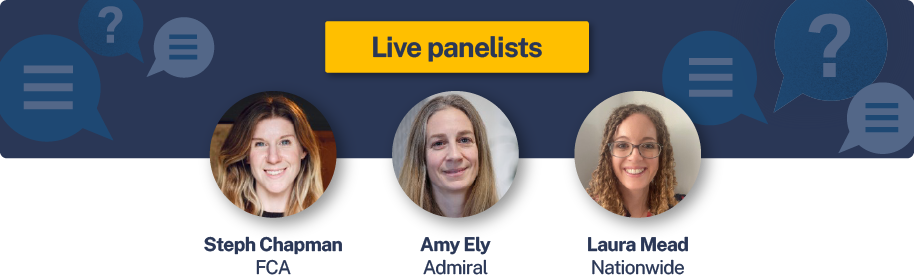
In June 2026 we brought together Stephanie Chapman from the FCA, Laura Mead from Nationwide, and Amy Ely from Admiral to explore what good customer understanding looks like in practice and how firms are putting customer understanding at the centre of how they communicate.
Watch The session
Five key takeaways from the panel
1. Invest in your comms people, so that they want to produce better communications
- skip to 14:28
The firms getting the most from Consumer Duty are investing in the people who create and approve communications. That means tiered training covering practitioners, approvers, and new starters. But training alone isn't enough. The strongest firms also support their people in other ways, such as developing interactive toolkits, using video of lived experiences, and leveraging available research to bring the customer to life for colleagues. Train and support people so they develop a shared vision of what ‘good’ looks like and they will strive to deliver it. Culture isn't a by-product of good communications. It's a precondition.
You can find out how Nationwide inspired their comms creators in our latest report, Better Understanding, Better Outcomes, on p.6
2. Some customers say they want everything. Less information is easier to understand. How to strike the balance
- skip to 18:55
Lived experience panels make this tension concrete: some customers want to get through a purchase as quickly as possible with minimal information. Others feel underserved if the detail isn't there. But it goes further than preference - what customers say they want isn't always a match for what they can actually understand. Designing for what people prefer risks leaving people confused.
The answer isn't to pick one, it's to layer. Lead with what the customer needs to act. Put everything else behind it. Complex insurance documents are a strong example: fees can be moved to the front, and required information can follow, with clear signposting. The information doesn’t need to change. The structure does.
You can read about Admiral’s redesigned ‘YAWEUI’ essential terms document in our latest report, Better Understanding, Better Outcomes on p.18
3. Test, measure, improve, then do it again
- skip to 21:43
Testing doesn't have to be complex or costly. The FCA sees a wide range of valid approaches, from firms picking up the phone to ask customers whether a letter made sense, to live calculators, to AI and call analysis that picks out where customers are asking questions because they didn't understand what was sent to them. What matters is that it's proportionate to your business, your customer base, and the channels you use.
If the communication doesn't shift the outcome, go back, learn, and refine it. There will always be a cohort of customers who don't engage, and if that's what the data shows, it might be the format that's wrong, not just the content. Continuous improvement is the method.
4. Regulatory prescription sets a floor. Not a ceiling
- skip to 27:58
There's a genuine tension between Consumer Duty and older, more prescriptive rules, and it's a fair frustration. But prescribed formats are not a reason to do nothing. Where firms are still required to provide information in a specific format, the strongest of those are adding a Plain Numbers' layering principle on top; an overlay that tells the customer what they're receiving and what they need to know, before the mandated content follows.
Consumer credit rules, are a good example: even within existing prescription, there is still an opportunity to double the proportion of customers who understand. The FCA is actively working through its handbook to consult on legacy regulation that might conflict with Consumer Duty. In the meantime, there is always something that can be done.
5. Outcomes monitoring is where the real proof sits
- skip to 34:06
The firms getting the most from Consumer Duty aren't just updating their communications and moving on. They're closing the loop by checking outcomes. The FCA isn't looking for a dashboard showing all the journeys you've updated. It wants to see the 'so what?'. What actually changed as a result?
The strongest examples show firms identifying where to improve, testing as they develop, and then evidencing the change in outcomes. Persistent debt communications are a good example. Nationwide found that by showing customers the real financial cost of their behaviour (made visual and specific through behavioural science, the Plain Numbers Method, and visual devices) the early results are clear: more customers are making above minimum payments, and more are fixing their direct debits. When the words and numbers work together and are centred around customer intent, outcomes change. And when customers feel understood, trust in the brand grows too.
The firms getting ahead aren't waiting for perfect
Consumer Duty will keep evolving, and so will the customers it's designed to protect. The consumer of today will have a very different experience to the consumer of five or ten years' time. The firms that treat customer understanding as a fixed destination will always be playing catch-up. The ones getting ahead are comfortable with imperfection but committed to continuous improvement. They actively test, sometimes get it wrong, learn from the data, and go again. And then they go again.

Interested in what this could mean for your communications?
Contact us to book a call and talk through how Plain Numbers can help you improve customer understanding.